Every figure on this page links to a public source.
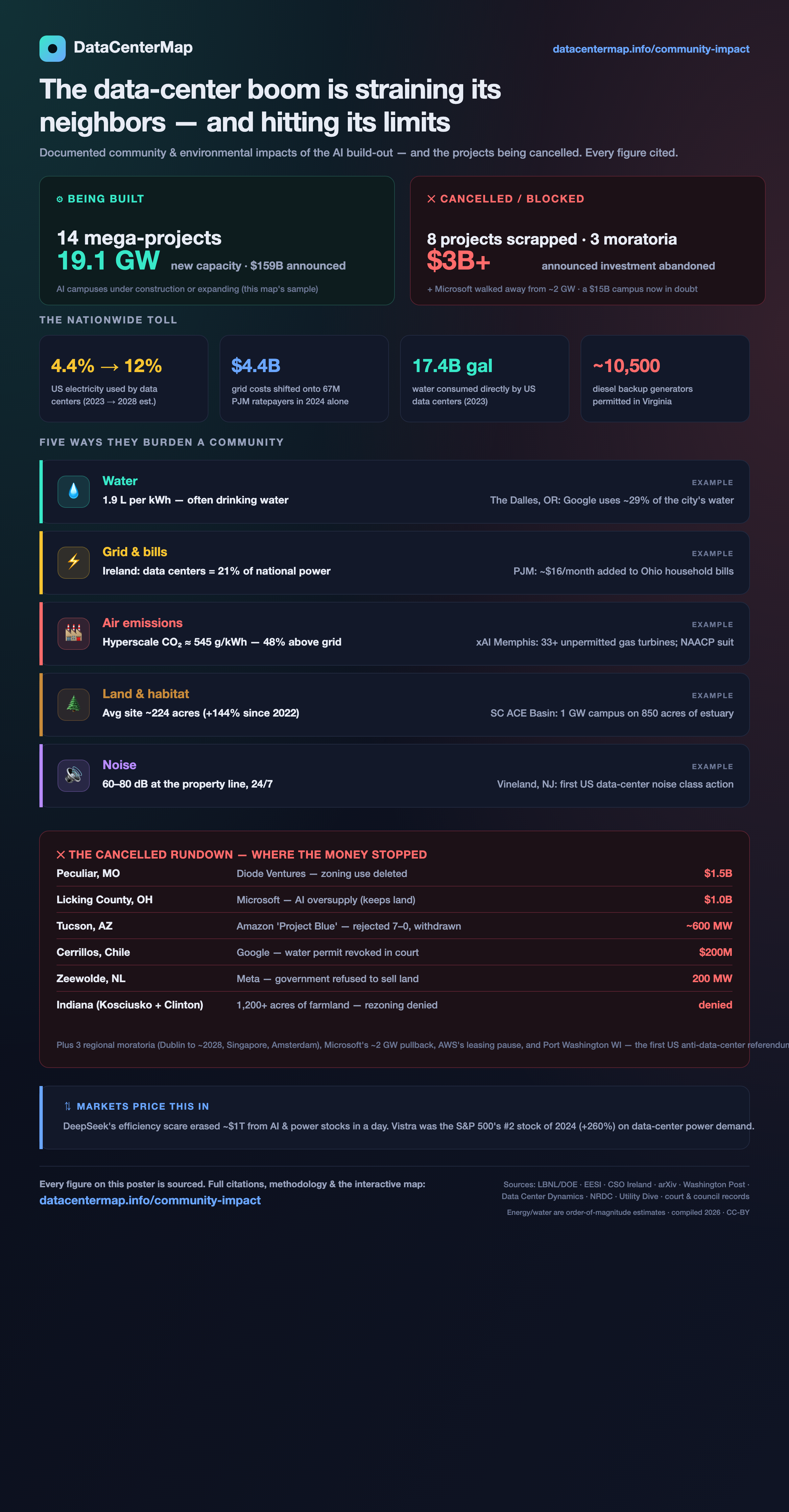
The AI build-out is one of the largest, fastest infrastructure pushes in history — and it lands in real neighborhoods. This report maps the documented impacts on nearby communities (water, energy bills, air, land and noise), the 8 projects cancelled or blocked by the people who live there, and the 14 mega-campuses still being built. Then open the interactive map to see what's near you.
17.4 billion gallons consumed directly in 2023US data-center direct water consumption (2023) and industry-average WUE eesi.org ↗ · eta-publications.lbl.gov ↗
22% of all metered electricity in Ireland in 2024Ireland data-center share of national metered electricity (2024) cso.ie ↗ · siliconrepublic.com ↗
US residential prices up ~11.5% in 2025US residential electricity rate increases linked to data-center demand surge eesi.org ↗ · cnbc.com ↗
~545 gCO2/kWh for hyperscale DCs vs ~370 gCO2/kWh US grid average — about 48% higherUS hyperscale data-center carbon intensity vs national grid average arxiv.org ↗ · eesi.org ↗
60–80 dB continuous at property lineData-center noise levels near homes and regulatory thresholds lsars.com ↗ · eesi.org ↗
Average site ~224 acres (a 144% increase since 2022)Average data-center site footprint and farmland conversion trend wri.org ↗ · fortune.com ↗
Typical 100 MW campus: ~850 construction workers → 100–200 permanent jobs (4–8:1 ratio)Construction jobs vs. permanent jobs at data centers thisislaborwise.com ↗ · dcgeeks.com ↗
9.3 trillion liters per year by 2030 — equal to the basic annual domestic water needs of all 1.3 billion people in Sub-Saharan AfricaProjected global AI data-center water footprint by 2030 (UN University, June 2026) unu.edu ↗ · news.un.org ↗
What the data tells us
Conclusions we draw directly from the 22 cases, 11 cancellations/moratoria, 14 in-process projects and 10 national datasets above. This is our interpretation — every claim traces back to the cited figures on this page.
1
Water and the grid are the flashpoints — not noise or carbon
Of the 22 place-specific conflicts we catalogued, 13 are fundamentally about water (7) or electricity, the grid and bills (6) — far more than air emissions (2), land & habitat (4) or noise (3). The pattern repeats: a facility lands in a drought-stressed or grid-constrained place and competes with residents for the two things a town can least spare. It is why Tucson, Chile and Uruguay fights are about water, and why Ireland, Virginia and Ohio fights are about power and bills.
2
The backlash is real — but the boom dwarfs it, roughly 54-to-1
Set the two ledgers side by side from our own data: about $159B of announced investment is still being built across 14 tracked mega-campuses (~19.1 GW), against roughly $3B abandoned across the 8 documented cancellations with disclosed costs. For every dollar a community has clawed back, on the order of 54 are still going into the ground. Cancellation is the exception; build-out is the rule.
3
Community opposition is escalating — and increasingly effective
The documented conflicts and cancellations cluster hard in the last three years (6 in 2024, 18 in 2025, 7 in 2026 in this set) and the tools are getting sharper: unanimous council rejections (Tucson, Chesapeake), counties deleting "data center" from their zoning code (Peculiar), the first US anti-data-center referendum (Port Washington, WI), and 3 regional moratoria (Dublin, Singapore, Amsterdam). Where a court can still override a local "no" (Saline Township, MI), the fight simply moves to the courthouse.
4
The costs land on people who don't get the upside
The clearest financial harm in the data is cost-shifting onto ratepayers: data centers drove $4.4B of 2024 PJM transmission costs spread across 67 million people (≈$16/month on Ohio bills), even as a 100 MW campus typically yields only 100–200 permanent jobs for hundreds of millions in tax breaks. Residents shoulder higher bills, more truck traffic, noise and water stress; the jobs and profits accrue elsewhere.
5
A handful of operators recur across the conflicts
The same names appear again and again — Google, Amazon, Meta, Microsoft, OpenAI turn up across the majority of the documented harm cases and cancellations in this dataset. That concentration matters: a small number of corporate siting and procurement decisions are setting the terms for water, power and land in dozens of communities at once.
6
It concentrates where water is scarce and power is cheap
Geographically, the conflicts cluster in a familiar set of US states (SC, NJ, IN, MS, IL) and a handful of countries abroad (6, incl. Ireland, the Netherlands, Chile and Singapore) — exactly the drought-prone, cheap-power, light-regulation places the industry is drawn to. The harms aren't random; they track the siting logic.
Five ways data centers burden a community
💧
Water
~1.9 L / kWh
Cooling can consume millions of gallons a day — often treated drinking water — in drought-prone regions. Global AI water use is projected to hit 9.3 trillion litres/yr by 2030.
⚡
Energy & bills
+$16/mo
Grid upgrades and capacity prices driven by data centers get spread to ordinary ratepayers. In Ireland, data centers already use 21% of national electricity.
🏭
Air emissions
545 gCO₂/kWh
Hyperscale carbon intensity runs ~48% above the grid average, and diesel/gas backup generators emit NOx and fine particulates beside homes — with measurable health damage.
🌲
Land & habitat
~224 acres
The average campus footprint rose 144% since 2022. Prime farmland and wetlands are converted permanently — and many proposals sit on ecologically sensitive land.
🔊
Noise
60–80 dB
Cooling systems hum 24/7 at the property line; generator tests hit 95–100 dB. Sustained exposure is linked to sleep loss, stress and elevated blood pressure.
22 documented cases, mapped to a place
Each is attributed to public reporting, regulators or court records. Filter by impact:
💧Water
Google data centers use ~29% of The Dalles' water
The Dalles, Oregon · USA · Google · 2021–2026
Google's data centers consumed 355 million gallons in 2021 — about 29% of the city's water — and demand has nearly tripled since 2017. The city is now seeking to draw more water from Mount Hood National Forest, raising river-depletion concerns.
≈355M gallons/yr (29% of city water); ~1M gallons/day
Drought-era water use halts Google's Santiago expansion
Quilicura, Santiago · Chile · Google · 2015–2023
Google's Quilicura site used 397 million liters of drinking water in 2023 — enough for ~80,000 people. Amid a 15-year drought, Chile's environmental court partly revoked the permit for a second data center, forcing a switch to air cooling.
“It's not drought, it's pillage” — Google in Uruguay
Canelones · Uruguay · Google · 2021–2023
Google's proposed data center initially required 7.6 million liters of potable water daily — the use of ~55,000 people — during Uruguay's worst drought in 70 years. Public backlash forced a redesign around air cooling.
7.6M L/day proposed (≈55,000 people); redesigned to air cooling
Meta data center linked to fouled wells in Georgia
Social Circle, Newton County, Georgia · USA · Meta · 2018–2025
Meta's data center uses ~500,000 gallons/day (≈10% of county water) and has been tied to well-water failures, sediment and pressure loss for neighbors. Newton County projects a water deficit by 2030.
≈500,000 gal/day (≈10% of county); neighboring wells affected
Amazon seeks +48% water in drought-stricken Aragón
Zaragoza, Aragón · Spain · Amazon · 2022–2024
Amazon's three Aragón data centers are licensed for 755,720 m³/yr; in 2024 it requested a 48% increase in a region that gets a quarter of Virginia's rainfall and where 75% of Spain faces desertification risk.
Phoenix-area data centers used ~385 million gallons in 2024 as the Colorado River shrinks; 150+ facilities operate in the region and demand is projected to rise ~400%.
Ireland freezes new Dublin data-center grid connections
Dublin · Ireland · Amazon, Google, Microsoft, Meta · 2021–2028
Facing data centers at ~22% of national electricity (≈50% of Dublin demand), EirGrid/CRU imposed a de-facto moratorium on new Dublin grid connections, with no new applications considered until 2028.
22% of Ireland's electricity; ~50% in Dublin; moratorium to 2028
Loudoun County, Northern Virginia · USA · AWS, Google, Microsoft, Meta · 2023–2025
The world's largest data-center cluster (4GW+ connected) has driven summer peak load up 23% and winter up 45% since 2019. PJM's reserve margin is projected to fall from 23% to ~5%, with capacity prices up 833% and 70,000 MW of requests pending.
xAI's Colossus ran unpermitted gas turbines in South Memphis
Boxtown, South Memphis, Tennessee · USA · xAI · 2024–2025
Short of grid power, xAI's Colossus ran dozens of unpermitted gas turbines around historically Black South Memphis and Southaven, MS — likely the area's largest NOx source (estimated 1,200–2,508 tons/yr), with nearby NO₂ up ~79%. In May 2026 the NAACP asked a federal court for emergency action to halt the pollution.
Zeewolde, Flevoland · Netherlands · Meta · 2021–2023
After government and Senate opposition over grid strain and a 166-hectare footprint, Meta's planned 200 MW hyperscale campus was blocked — the government refused to sell its plot and the project was cancelled.
Citing grid strain, Amsterdam and Haarlemmermeer froze new data-center construction in 2019; the grid operator warns of shortages to 2030. Projects of 70 MW+ or over 10 hectares remain restricted across much of the country.
Grid saturation to 2030; 70 MW+ projects restricted
Singapore paused data-center growth to protect supply
Singapore · Singapore · Digital Realty, Equinix, Others · 2019–2022
Singapore imposed a 2019 moratorium on new data centers over electricity and water use (then ~7% of national power, projected 12% by 2030). It reopened in 2022 under a tightly controlled, green-energy-linked allocation regime.
~7% of national electricity (2020); moratorium 2019–2022
Great Oak, Manassas, Virginia · USA · Amazon Web Services · 2022
An AWS data center ~700 feet from 291 homes produces constant cooling-system noise; residents report sleep disruption, migraines and vertigo. Amazon later cut noise by ~10 dB, but impacts persist.
≈700 ft from homes; ~10 dB reduction after complaints
Brittany Heights, Chandler, Arizona · USA · CyrusOne · 2014
A CyrusOne data center generated continuous low-frequency hum from its cooling systems, disrupting a residential neighborhood. The company spent ~$2 million on noise attenuation after sustained complaints.
$17B campus threatens 103 acres of Georgia wetlands
Newnan, Coweta County, Georgia · USA · Prologis, Atlas · 2025
“Project Sail,” a 832-acre, 600 MW hyperscale campus, was approved with limited review of ~103 acres of wetlands in the Wahoo Creek / Chattahoochee watershed. Residents sued over water, wetlands and noise.
Monrovia, Morgan County, Indiana · USA · Google · 2025–2026
Google's 550-acre campus converts rural farmland to industrial use; residents sued, arguing approvals violated a county plan protecting natural resources, and warned of up to 3 million gallons/day of water use per building.
Wetlands cleared for Google's Fort Wayne expansion
Fort Wayne, Indiana · USA · Google · 2025
Indiana's environmental agency let Google eliminate 2+ acres of wetland habitat for a data-center expansion, requiring purchase of ~4 acres of wetland mitigation credits to offset the loss.
10,500+ diesel backup generators permitted in Virginia
Northern Virginia · USA · Multiple · 2025–2026
Virginia has permitted ~10,500 diesel backup generators (≈27 GW) at data centers. Even with minimal runtime they emit NOx and fine particulates; analyses estimate ~3 premature deaths/yr, prompting tighter 2026 emissions rules.
≈10,500 generators (~27 GW); est. ~3 premature deaths/yr
QTS drew nearly 29 million gallons from the county water system through two connections—one installed without utility knowledge, one unbilled—over up to 15 months. Residents in the adjacent Annelise Park subdivision reported unusually low water pressure, which triggered the investigation; the utility then billed QTS $147,474 in retroactive charges but levied no fine.
~29 million gallons drawn without payment; residents told to stop watering lawns
First US data-center noise class action filed in Vineland, NJ
Vineland, New Jersey · US · DataOne USA, Nebius Group · 2026
Residents near DataOne USA's AI data center construction site in Cumberland County filed a federal class-action lawsuit in May 2026, alleging round-the-clock humming from diesel generators and cooling equipment disrupts sleep and diminishes property values across roughly 1,013 homes within a mile of the facility. The county health department issued a Notice of Violation in March 2026 after confirming noise exceeded the 50 dB nighttime limit.
Noise >50 dB (10 pm–7 am); ~1,013 homes within 1 mile affected
Data centers shift $4.4B in grid costs onto 67M PJM ratepayers
PJM Interconnection (Ohio, Virginia, Maryland, PA, IL, NJ, WV) · US · Amazon, Google, Microsoft, Meta · 2024
Data centers in the PJM grid region triggered over 150 local transmission upgrade projects in 2022–2024, with $4.4 billion in approved transmission costs in 2024 alone—costs regulators spread across all 67 million ratepayers rather than assigning to the data centers causing them. Data centers drove 63% of the sharp 2025/26 capacity price surge, adding roughly $16 per month to Ohio households and projecting up to $163 billion in cumulative excess bills through 2033.
$4.4 billion transmission costs in 2024; ~$16/month added to Ohio household bills
1 GW campus proposed in South Carolina's pristine ACE Basin
Colleton County, South Carolina · US · Eagle Rock Partners · 2025
Eagle Rock Partners proposed a nine-building, 1-gigawatt data center campus on 850 acres of Weyerhaeuser timberland in the ACE Basin—one of the largest intact estuarine ecosystems on the Atlantic Coast—requiring deforestation and impacting over 200 acres of wetlands. Hundreds of residents packed a December 2025 public hearing to oppose it, state legislators denounced the project, and Colleton County Council imposed a six-month moratorium on data center approvals in early 2026.
Communities, courts and regulators have stopped or frozen a growing list of projects. Below: where the money stopped. Costs are announced investment that won't be built there — not all of it was spent, though land, permits and pre-construction are often unrecoverable.
TD Cowen analysts reported in March 2025 that Microsoft had cancelled or deferred leases totaling roughly 2 GW of data-center capacity across the US and Europe — including forgoing some capacity tied to OpenAI — citing AI compute oversupply. Google and Meta picked up some of the freed European capacity.
Amazon Web Services paused part of its colocation leasing pipeline
Amazon Web Services · 2025 · Leasing pause (mainly international)
Wells Fargo analysts said in April 2025 that AWS — the world's largest data-center user — had paused some colocation leasing discussions, mainly outside the US. AWS called it 'routine capacity management,' but it followed Microsoft's pullback and signaled cooling near-term demand.
In April 2026, Port Washington, Wisconsin became the first US city to pass a referendum restricting data-center deals — 66% of voters backed requiring voter approval for any tax incentive over $10M. It puts Vantage's announced $15B 'Stargate' AI campus with OpenAI and Oracle in doubt.
Saline Township, MI rejected a Stargate campus — a court forced it through anyway
Related Digital / Oracle / OpenAI (Stargate) · 2025 · Local rejection overridden in court
Saline Township's board voted 4–1 in September 2025 to deny rezoning for a $16B Oracle/OpenAI data center on farmland. The developer sued for 'exclusionary zoning'; an October 2025 consent judgment let the project proceed over the board's vote, and construction began that November — a stark example of community decisions being overridden.
The other side of the ledger — major projects under construction, expanding, or announced. Power (MW) and cost are reported estimates at full build-out and will change as projects phase in.
Markets: the same data points, priced in real time
Wall Street trades on the very numbers on this page — how much electricity data centers will draw, how fast they're built, and when projects get cancelled. Here is how our data points correlate with documented market moves.
“How much power will AI really need?” · Jan 2025
DeepSeek wiped ~$1T off AI & power stocks in a day
NVDA · VST · CEG · TLN · GEVNvidia −17% (−$589B)
When China's DeepSeek showed a frontier model trained far cheaper, markets re-priced the entire data-center power thesis in hours. Nvidia lost ~$589B — the largest one-day loss in US market history — and the AI-power trade cratered with it: Vistra fell ~28%, Constellation ~21%, and Talen and GE Vernova each over 20%, precisely because investors doubted data centers would consume as much electricity as feared. The grid strain communities worry about is the same number Wall Street capitalizes.
Data centers are driving record electricity demand · 2024
AI power was the best trade of 2024 — beating Nvidia
VST · CEGVistra +~260%
Vistra was the single best-performing stock in the S&P 500 in 2024, up roughly 260% and outrunning Nvidia, on the thesis that hyperscalers need vast 24/7 power for AI data centers; Constellation roughly doubled on the same demand. The surge in grid demand that is pushing up residents' bills (see PJM, Ireland) is the exact tailwind that made independent power producers Wall Street's darlings.
Data centers are reviving retired & nuclear generation · Sep 2024
A data-center deal restarted Three Mile Island — stock +22%
CEGConstellation +22% in a day (+32% for September)
Constellation signed a 20-year deal to restart Three Mile Island Unit 1 (renamed Crane Clean Energy Center) to power Microsoft's PJM data centers; its stock jumped ~22% the day of the announcement and ~32% over the month. New data-center load is not only straining existing grids — it is bringing shuttered and nuclear plants back online, and the market priced that in instantly.
Behind-the-meter co-location strains the shared grid · 2024
Regulators checked an $18B Amazon–Talen nuclear deal
TLNTalen +9.8% (after FERC snub)
Talen agreed to sell Amazon up to 1,920 MW from its Susquehanna nuclear plant in a 17-year, ~$18B deal — but FERC rejected the original behind-the-meter arrangement in November 2024 over its impact on the shared grid and other ratepayers, forcing a restructure. Talen still rose ~9.8% when Amazon reaffirmed support. It is a rare case of a regulator pricing in the community/grid externality the rest of the market had ignored.
Cancellations & the 2 GW Microsoft pullback · 2025
When the build-out wobbles, the whole AI trade does
MSFT · NVDAFueled the 2025 'AI overbuild' selloffs
TD Cowen's reports that Microsoft was cancelling and deferring ~2 GW of data centers — and that AWS had paused leasing — landed as evidence for an 'AI overbuild' thesis, repeatedly pressuring Microsoft, Nvidia and the broader AI complex through 2025. The same project cancellations communities celebrate are read by markets as a demand-signal — which is why every pullback headline moves billions.
The ~$159B of in-process projects we map is a slice of the whole: Amazon, Microsoft, Alphabet and Meta alone committed over $300B of capex in 2025, heading toward ~$725B in 2026 (up ~77%), with Goldman Sachs projecting $5.3T across 2025–2030. The community fights documented here are happening against the largest, fastest capital build-out in corporate history — which is also why investors increasingly ask whether the returns can justify it.
Market figures are point-in-time moves drawn from the cited reporting, included for context only — not investment advice.
Sources & method
Read this first. This is an awareness resource compiled from public reporting, government and utility data, NGO and academic reports, and court/council records. National energy, water and carbon figures are order-of-magnitude estimates, not metered per-facility readings. Project costs are announced values (not audited spend). Cancelled/blocked status reflects reporting at the time of writing; some projects relocate or revive. Provided AS-IS, with no warranty — verify against the linked primary sources before relying on any figure.
How many data center projects have been cancelled or blocked?
We document 8 specific projects cancelled, blocked or withdrawn since 2022 — including Amazon's "Project Blue" in Tucson, Meta's Zeewolde campus, and Microsoft scrapping ~$1B of Ohio sites — plus 3 regional moratoria (Dublin, Singapore, Amsterdam). Separately, TD Cowen reported Microsoft walked away from roughly 2 GW of US and European projects in 2025.
How much data-center investment has been abandoned?
At least $3B in announced investment across the documented cancelled or blocked projects with disclosed costs — led by a $1.5B campus in Peculiar, MO and ~$1B in Licking County, OH. That is announced project value, not money all spent; the recoverable-versus-sunk split (land, permits, pre-construction) varies by project. On top of it, Microsoft deferred or cancelled ~2 GW of capacity and a $15B "Stargate" campus is now in doubt after Port Washington, WI passed the first US anti-data-center referendum.
How do data centers harm the communities next to them?
The most-documented impacts are: heavy water use (often drinking water) in drought-prone areas; higher electricity bills and grid strain passed to ratepayers; diesel/gas backup-generator air pollution; conversion of farmland and wetlands; and constant cooling-system noise. This page lists 22 cited, place-specific cases.
Are these figures measured or estimated?
National statistics come from cited public reports (e.g. Lawrence Berkeley National Lab / DOE, EESI, the CSO of Ireland, a 2026 arXiv study, the Washington Post). Per-case figures come from named reporting, regulators, utilities and court or council records. Energy, water and carbon estimates are order-of-magnitude, not metered per-facility readings.
How much new data-center capacity is being built?
We track 14 major in-process campuses — roughly 19.1 GW of new capacity and about $159B in announced investment, from OpenAI/Oracle's Stargate in Abilene to Meta's 5 GW Hyperion in Louisiana.